


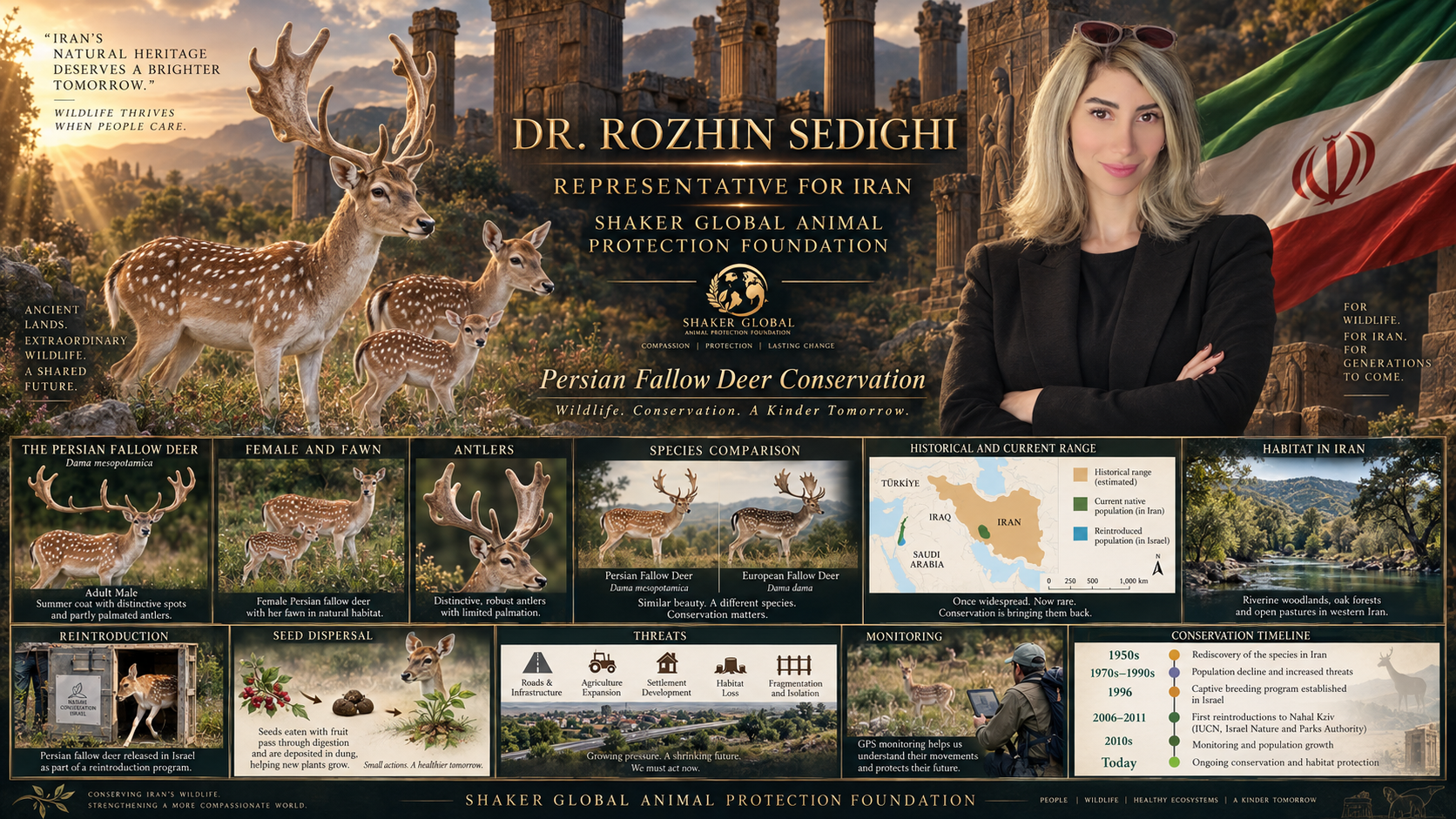
It had not. A tiny surviving population was reported in south-western Iran in the 1950s, hidden in dense vegetation beside the Dez and Karkheh rivers. That rediscovery began a conservation story shaped by Iranian protected areas, international captive breeding, carefully planned releases, difficult setbacks and decades of field monitoring.
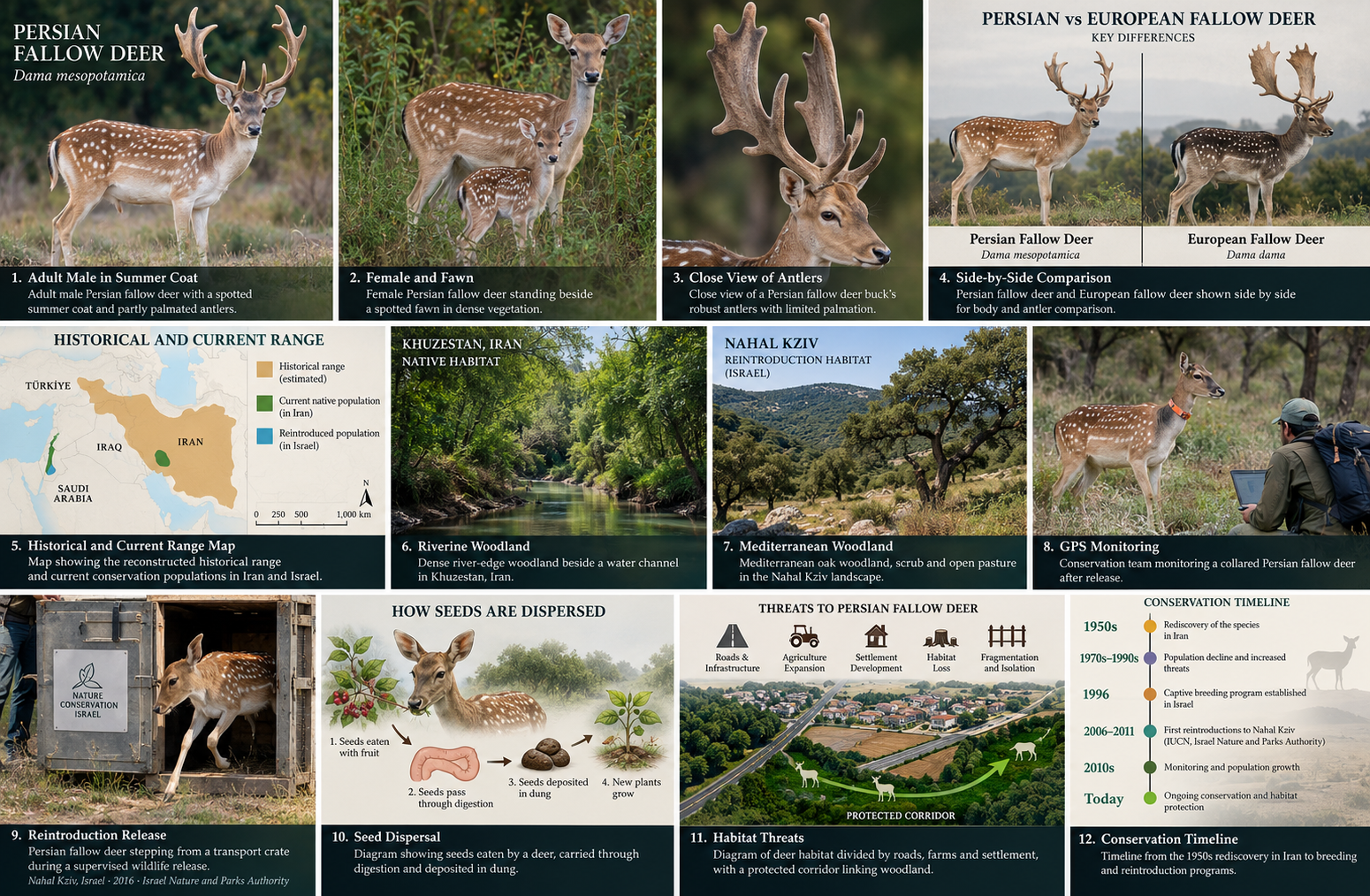
Today, the Persian fallow deer is still endangered. Free-ranging and managed groups survive mainly in Iran and Israel, but there is no single reliable current total that combines them all. Some deer live in native habitat, others in reintroduced populations, and many remain in fenced or intensively managed settings. Those categories matter: a deer inside a secure breeding enclosure contributes to survival, but it is not the same as a self-sustaining wild population.
This guide explains what the Persian fallow deer is, where it lives, how it differs from the European fallow deer, why it declined, what conservationists have learned from restoring it, and what must happen next. Its history is dramatic, but its future depends less on drama than on habitat, genetics, monitoring and patient long-term care.
Quick Facts About the Persian Fallow Deer
| Fact | Evidence-based summary |
|---|---|
| Common names | Persian fallow deer; Mesopotamian fallow deer; sometimes Iranian fallow deer |
| Accepted scientific name | Dama mesopotamica (Brooke, 1875). Some authorities and legal listings still use Dama dama mesopotamica as a subspecies name. [1][18] |
| Animal group | Mammal; even-toed ungulate; deer family Cervidae; genus Dama |
| Approximate size | Published reference measurements give a head-and-body length of about 180-190 cm for adult males and 160-170 cm for females; shoulder height is roughly 100-110 cm in males and about 90 cm in females. [3] |
| Approximate weight | One major mammal reference reports about 120-140 kg for adult males and 70-80 kg for females, although weights reported by individual zoological institutions vary. [3] |
| Diet | Herbivorous mixed feeder. It grazes grasses and browses leaves, shoots, shrubs and seasonal fruits; diet changes with habitat and season. [9][10] |
| Activity | Often most active around dusk, at night and near dawn, although activity changes with disturbance, cover, weather and local management. [3][9] |
| Social life | Commonly solitary or in small, changing groups in studied reintroduced populations; large permanent herds should not be assumed to be the wild norm. [8][9] |
| Geographic range today | Native remnants and managed populations in Iran; free-ranging reintroduced populations and breeding groups in Israel. [1] |
| Preferred habitat | Riverine woodland, dense thickets, Mediterranean woodland, scrub and nearby open feeding areas, with reliable water and refuge cover. [3][9] |
| Conservation status | Endangered on the IUCN Red List. The current listing is based on a 2015 assessment, with an errata version published in 2016, not on a complete 2026 global census. [2] |
| International trade status | Listed in CITES Appendix I under the name Dama dama mesopotamica. [18] |
| Main threats | Very small and fragmented populations, habitat loss and degradation, low genetic diversity, inappropriate translocation, livestock and human pressures, roads, dogs and other predation risks, drought or water stress in some sites, and disease or management failures. |
| Lifespan | A dependable maximum for wild animals is not well established. Managed-care sources commonly report a lifespan of roughly two decades or more, but this should not be treated as a typical wild lifespan. |
Status note: The label "Endangered" does not mean that every surviving deer is wild, genetically equivalent or living in secure habitat. Conservation assessments focus on extinction risk, mature animals, population structure and future threats, not simply the largest total that can be assembled.
What Is a Persian Fallow Deer?
The Persian fallow deer is a large, spotted deer native to West Asia and one of two living species commonly placed in the genus Dama. The other is the European fallow deer, Dama dama. The American Society of Mammalogists' Mammal Diversity Database recognizes the Persian animal as the separate species Dama mesopotamica, which is also the name used by the modern IUCN Red List assessment. [1][2]
That tidy answer needs one qualification. Taxonomy has changed over time, and some databases, laws and older scientific papers treat the animal as a subspecies of the European fallow deer: Dama dama mesopotamica. CITES still lists it under that trinomial name. The different labels do not refer to different conservation populations; they reflect a continuing history of classification. For a public-facing article, Dama mesopotamica is the clearest current primary name, while the subspecies name remains important when searching older literature or legal records.
Like all deer, the Persian fallow deer is a ruminant. It has a multi-chambered stomach that allows it to digest fibrous plant material. Males are called bucks and females are called does. Adult males grow antlers, shed them and regrow them in an annual cycle; females do not normally carry antlers.
The species matters for more than rarity. It is a surviving branch of the native large-mammal community of West Asia, a herbivore that can influence vegetation and carry seeds, and a test case in modern reintroduction science. Research on its releases in Israel has helped conservationists understand how captive-raised animals establish home ranges, recover anti-predator behaviour and respond to different release strategies. [6][7][8][11]
Its identity also carries a warning. A species may rise in total numbers while remaining vulnerable if most individuals descend from very few founders, live behind fences or occupy isolated sites. Persian fallow deer conservation is therefore not just an exercise in producing more deer. It is an attempt to rebuild viable, connected and ecologically functioning populations.
What Does the Persian Fallow Deer Look Like?
The Persian fallow deer has the elegant outline of a fallow deer but a heavier, longer-bodied build than the European species. An adult male may approach two metres from nose to rump. Mature bucks have thick necks, deep chests and a more powerful appearance during the breeding season. Females are smaller and more lightly built. [3]
The summer coat is usually warm reddish-brown to ochre, patterned with white spots. The underside, rump and parts of the tail are paler. A darker line can run along the back and through the centre of the tail. In winter the coat becomes greyer, browner and thicker, so the spots may look less bright. Individual colour varies, and photographs taken under different light can make the same animal appear surprisingly different.
The antlers provide the quickest visual clue in an adult male. European fallow deer are famous for broad, shovel-like palmation near the top of the antlers. Persian fallow deer antlers are generally more robust but less fully palmated. A major mammal reference describes them as about 50-55 cm long, with only limited flattening, and a comparative acoustic study likewise identifies reduced palmation as a noticeable difference. [3][12]
Antlers are bone, not permanent horns. They grow under a soft, blood-rich covering called velvet. Once growth is complete, the velvet is shed and the hard antlers are used in display and competition during the rut. Later the antlers are cast, and a new pair begins to grow. Timing can differ by place and condition, but south-west Iranian reference accounts describe rutting in late summer and antler casting around late winter. [3]
Spots are not merely decorative. In a landscape of broken sunlight, leaves and shadow, a spotted coat disrupts the outline of the body. Fawns are especially dependent on concealment in dense vegetation. Adults also use thickets as refuge, particularly when they are unfamiliar with a landscape or perceive greater risk. Field studies of reintroduced deer have shown that safe cover can be central to the first years of home-range establishment. [9]
Size measurements deserve a little caution. Published zoological references and zoo fact sheets do not always agree, partly because sex, age, health, captive diet and measurement method differ. The most defensible public summary is that Persian fallow deer are generally larger than European fallow deer, males are much heavier than females, and a single exact weight should not be presented as universal.
Persian Fallow Deer vs. European Fallow Deer
Persian and European fallow deer are close relatives with spotted coats, sexually dimorphic bodies and annual antler cycles. Modern taxonomic authorities generally recognize them as separate species, but older and some current systems still use a subspecies treatment. Genetic research has identified distinct gene pools, while also confirming that the two forms can produce fertile hybrids. [1][4][12]
| Feature | Persian fallow deer | European fallow deer |
|---|---|---|
| Current scientific treatment | Usually Dama mesopotamica | Dama dama |
| Native centre of range | West Asia | Eastern Mediterranean and Anatolian refugial range; now introduced widely around the world |
| Conservation position | Endangered, with small native, reintroduced and managed populations | Globally widespread and often abundant outside its original range |
| Average build | Generally larger and heavier | Generally smaller |
| Adult male antlers | Less broadly palmated; robust with limited flattening | Usually strongly palmated in mature bucks |
| Rut timing in studied populations | Often late summer, around two months earlier than British and Irish European fallow deer populations | Commonly peaks in autumn in temperate European populations |
| Male rut calls | Longer, slower pulsed groans in the 2014 comparison | Shorter groans and much higher calling rates in the compared European populations |
| Wild ecology | Species-specific knowledge remains limited; much modern evidence comes from reintroduced populations | Extensively studied across many countries and habitats |
The contrast must not be pushed too far. Coat patterns overlap, antler form changes with age, and an individual animal cannot always be identified reliably from a distant photograph. The safest identification uses location, management history and expert examination alongside appearance.
Behavioural comparisons require even more care. European fallow deer have been studied for decades, so it is tempting to fill gaps in Persian fallow deer knowledge with European data. Sometimes this offers a useful hypothesis, but it does not create species-specific evidence. For example, a 2021 Persian fallow deer home-range study cited European feeding research as context, while separating those comparisons from observations made directly on the reintroduced Persian population. [9]
The differences are not only visual. In a study of rutting males, Persian fallow deer produced longer groans with fewer pulses and far lower average calling rates than European bucks recorded in Britain and Ireland. The authors also noted that climate and captive conditions could have contributed, which is exactly the sort of caution good wildlife interpretation needs. [12]
Where Does the Persian Fallow Deer Live?
Today, Persian fallow deer occur in Iran and Israel, but the meaning of "occur" differs between the two countries. Iran holds the surviving native lineage in the species' original range as well as several fenced, semi-wild and translocated groups. Israel holds conservation-breeding herds and free-ranging populations restored to parts of the species' historical Levantine range. [1][13][16]
Historical range
Historical and zooarchaeological evidence places Persian fallow deer across parts of West Asia, including Iran, Iraq and the Levant, with records or reconstructions also involving eastern Turkey. The Mammal Diversity Database summarizes the former range as Iraq, Israel, Jordan, Lebanon, eastern Turkey and possibly Syria, with survival in western Iran. [1]
Range maps should be read as reconstructions, not precise modern boundaries. Animal distributions changed over thousands of years, people moved fallow deer among islands and managed landscapes, and older reports sometimes used names differently. It is safer to say that the species once occupied a much broader West Asian range than to imply that every part of a shaded map supported a continuous population.
Native habitat in Iran
The remnant deer rediscovered in south-western Iran were associated with dense riverine woodland along the Dez and Karkheh systems. Reference descriptions mention poplars, willows and tamarisk, while early accounts emphasise thick gallery forest: strips of trees and shrubs following river channels through a hotter, drier landscape. [3][19]
These habitats offered several essentials at once. Dense cover helped deer avoid people and predators. River systems supported vegetation through dry periods. Openings and edges provided grasses, while shrubs and trees offered leaves, shoots and fruits. Protecting only a patch of trees without its water regime, feeding areas and surrounding movement routes would protect only part of what the deer needs.
Iranian conservation later moved animals to a range of sites, including Dasht-e-Naz in Mazandaran, Ashk Island in Lake Urmia, Miankotal in Fars and several other enclosures or protected areas. These translocations spread risk, but they also placed deer in climates and ecological settings unlike the original Dez-Karkheh habitat. A 2024 climate-niche study found marked climatic differences between the original area and eleven translocated areas and urged future projects to consider climate similarity alongside other release criteria. [14]
Reintroduced habitat in Israel
The best-studied free-ranging population began in the Nahal Kziv Nature Reserve in the western Galilee. The landscape is a mosaic of dense Mediterranean oak woodland, scrub and open pasture, centred on a deep ravine with year-round water. Releases began in 1996 and continued for more than a decade. [6][9]
Another program developed in the Judean Hills, including the Soreq landscape and later Nahal Dolev. These areas combine rugged slopes, woodland, scrub, grassland and human infrastructure. Monitoring has used direct observations, camera traps, radio telemetry and GPS collars. In May 2026, nine zoo-born deer were released at Nahal Dolev, and the Jerusalem Biblical Zoo reported an estimated 110 deer in the wider Judean Hills population. [17]
Habitat, then, is more than a vegetation label. A suitable site must provide food, water, refuge and room for population growth. It must also be connected enough for animals to disperse without funnelling them toward roads, railways, farms or dense settlement.
A Species Once Thought Lost
The history of the Persian fallow deer contains two different discoveries. The species first entered Western science in the nineteenth century, when Victor Brooke described Cervus (Dama) mesopotamicus in 1875 from specimens linked to what is now Iran. Over the following decades, however, reliable reports became scarce. By the 1940s and early 1950s it was widely feared extinct. [1][4]
Then came reports from Khuzestan. In 1956, a handful of deer were seen in the dense river forests of south-western Iran. Later accounts often describe roughly two dozen to thirty animals, but the number was an estimate rather than a modern census. What mattered most was the proof: the species still existed. [4][19]
The location helps explain how it survived. Gallery forest along the Dez and Karkheh rivers could form a green screen of vegetation, difficult to enter and harder to survey. In a region where hunting and habitat change had removed deer elsewhere, the last animals had found refuge in a narrow living corridor.
Protection followed. Iranian authorities secured habitat and, between 1964 and 1967, captured six deer from the last stronghold. Five helped establish the Dasht-e-Naz breeding population near the Caspian Sea; another male was sent to Germany to strengthen the small breeding effort at the Opel Zoo. These were tiny founder groups, and every loss mattered. [4][5]
The international breeding history was not simple. The original German male died, and European fallow deer were used in crossings before another Persian male arrived. Hybrids were later sent to Iran but were reportedly separated from the pure Persian stock. Decades afterward, a genetic study of sampled Iranian, German and Israeli material found clear differentiation between Persian and European fallow deer and no evidence of recent hybrid ancestry in the Persian samples it tested. The authors also warned that their old Iranian samples could not represent every present-day animal. [4]
Iran expanded the conservation program by moving deer to other protected or managed locations. Israel established a breeding core at Hai-Bar Carmel in 1976 from two males and five females of German and Iranian origin. By the mid-1990s, that herd had grown enough to support a planned reintroduction, and releases began at Nahal Kziv in 1996. [6]
The story is sometimes told as a neat rescue: rediscovery, breeding, release, recovery. Reality was less smooth. Some translocated Iranian groups declined. The Ashk Island population fell sharply between reported 2009 and 2021 counts. Early Israeli releases faced dog attacks, adjustment stress and lower first-year survival. A study in the Soreq Valley found that deer from two breeding facilities responded differently after release, showing that even routine captive conditions can shape survival in the wild. [11][13]
Yet the larger achievement remains extraordinary. A species reduced to a tiny remnant survived long enough for conservationists to protect founders, build breeding groups, test release methods and establish free-ranging descendants in parts of its former range. The lesson is not that extinction is easily reversed. It is that determined action taken before the last animals disappear can preserve options that would otherwise be lost forever.
How Many Persian Fallow Deer Are Left?
There is no single reliable 2026 global count of Persian fallow deer. Published figures mix different years and categories, including native wild deer, reintroduced free-ranging deer, animals in large fenced reserves, intensively managed breeding groups and zoo populations. Adding those figures together would create a number that looks precise but is not scientifically comparable.
Several dated snapshots are still useful:
• The IUCN Red List currently shows the species as Endangered based on its 2015 assessment, with an errata version published in 2016. That assessment should not be presented as a current census. [2]
• A 2022 Deer Specialist Group compilation assembled Iranian site reports for 2021. It listed 282 animals across sites with available recent counts, while several sites had no updated number. Many of the counted deer were in fenced or semi-wild areas. [13]
• The same Iranian compilation showed why totals can change dramatically: the reported Ashk Island population fell from 288 in 2009 to 29 in 2021, while some managed groups elsewhere increased. [13]
• A June 2025 report described 90 deer at the 300-hectare Arsanjan breeding centre and documented releases to Dez National Park, including evidence of a wild-born fawn after release. [15]
• The Jerusalem Biblical Zoo's conservation page states that at least 300 Persian fallow deer live free-ranging in Israel, with additional animals in breeding groups. In May 2026, the zoo reported an estimated 110 deer in the Judean Hills alone. [16][17]
These figures should not be summed. Some are minimums, some are estimates, some refer to overlapping geographic groupings, and some distinguish wild from managed animals differently. The Iranian and Israeli counts also come from different monitoring systems.
Why counting is difficult
Persian fallow deer often use dense cover. Direct counts can miss animals, while camera-trap or track surveys may identify presence without estimating the whole population. Radio or GPS collars provide excellent information about tagged individuals but do not automatically count every untagged deer.
The biological categories are equally important. A free-ranging deer born in the wild contributes differently to recovery from a zoo-born deer awaiting release. An animal in a large enclosure may forage and breed with limited intervention but still depend on fencing, supplementary food or protection from predators. A useful global assessment needs separate, dated totals for each category and enough genetic information to show how populations are related.
The honest answer to "How many are left?" is therefore not a dramatic single number. It is that several hundred are known across different settings, conservation has increased the species far above its mid-twentieth-century low, and the number of securely wild, mature, connected and genetically well-managed animals remains the most important measure.
Why Is the Persian Fallow Deer Endangered?
The Persian fallow deer is endangered because its recovery rests on small, separated populations with a narrow genetic base, while habitat and human pressures continue. A local disease event, drought, management failure or cluster of deaths can have consequences that would be minor in a widespread species but serious here.
Habitat loss and degradation
Historical hunting drove much of the early decline, but habitat loss determines how much room recovery has today. River forests can be damaged by water extraction, altered flow, agriculture, grazing, fire, development and the removal of trees or undergrowth. Mediterranean woodland in Israel is also crossed by roads, railways, settlements and recreation routes.
Habitat quality is not simply the amount of green visible on a map. Deer need refuge cover, seasonal food and water within a workable daily range. A patch may look forested but fail if it is isolated, heavily disturbed or too dry during critical months. Planning studies in the Galilee found that development scenarios could sharply reduce high-quality habitat and disrupt the landscape through which a reintroduced population might expand. [8]
Small and fragmented populations
Small populations are vulnerable to chance. A few years with poor fawn survival, an imbalanced sex ratio or the accidental death of breeding females can alter growth. This is called demographic stochasticity: random variation in births and deaths that matters most when numbers are low.
Fragmentation adds another layer. When groups are separated by roads, farms, cities or unsuitable habitat, animals have fewer opportunities to move and breed between them. A population may increase locally yet remain a collection of biological islands. Conservation therefore needs safe habitat corridors as well as protected cores.
Genetic concerns
Every modern Persian fallow deer population has passed through a severe bottleneck. Genetic drift can remove alleles simply by chance, while mating among relatives can increase inbreeding. A 2012 microsatellite study found strong differentiation between Persian and European fallow deer, but also evidence of lost allelic richness and very low heterozygosity in sampled captive-origin Persian groups. The older wild Iranian material held more allelic richness than the sampled German and Israeli breeding stocks. [4]
This does not mean that every small group is doomed or that managers should mix populations without a plan. Moving animals can preserve diversity and reduce close inbreeding, but it can also spread disease or combine lineages with uncertain histories. Genetic sampling, studbooks and coordinated breeding decisions are essential.
Predation and free-ranging dogs
Predation is natural, but a small reintroduced population may not absorb high losses. Wolves are a potential natural predator in parts of the Israeli study landscape. Free-ranging or feral dogs have caused serious post-release mortality and create a risk closely linked to human activity. [6][9]
Captive-raised animals may also be slow to recognise danger. In the Soreq study, deer increased their flight distance and use of cover over the months after release, suggesting that anti-predator behaviour could be reacquired. Survival nevertheless differed sharply between animals originating from a busy public zoo and those from the less disturbed Hai-Bar facility. The study's practical conclusion was clear: breeding centres preparing animals for release should minimise unnecessary human disturbance. [11]
Poaching and other human pressure
Hunting was a central historical cause of decline. Direct poaching remains a concern wherever enforcement is weak, though its current importance varies among sites and should not be assumed without local evidence. Human presence can also affect deer indirectly through disturbance, dogs, fencing, wood collection and habitat conversion.
Roads and railways can kill animals and divide habitat. The 2025 Iranian reintroduction report identified a road near Dez National Park as a concern and described warning signs and lighting along an eight-kilometre section. The same project used community workshops to address deer entering agricultural fields at night. [15]
Livestock and agriculture
Domestic livestock can reduce food, alter vegetation, spread disease and bring herding dogs into deer habitat. The effect depends on stocking levels and season; coexistence is not automatically impossible. In Dez National Park, however, conservation workers specifically identified livestock, dogs, farming and inconsistent enforcement as risks to released deer. [15]
Agricultural land can also attract animals with nutritious food. That creates the possibility of crop damage, vehicle collisions and negative attitudes among local people. Preventing conflict through land-use planning, compensation or practical deterrents is often cheaper and more humane than reacting after resentment grows.
Drought, water and climate pressures
Water availability is especially important for a deer associated with riverine woodland and dry-season refuges. Drought can reduce both drinking water and the plants that deer eat. Changes around Lake Urmia have affected island ecosystems, and the collapse in reported numbers on Ashk Island shows why apparently secure sites can become vulnerable when environmental conditions change. [13]
Evidence should be framed carefully. A 2024 study did not prove a single climate-change-driven decline across the species. It showed that many Iranian translocation sites have climatic conditions very different from the original Dez-Karkheh area and that climate compatibility should be considered when choosing future sites. [14]
Disease, parasites and management risk
Concentrating animals in enclosed breeding areas can make feeding, veterinary care and protection easier. It can also increase exposure to infectious disease or parasites, especially when animals share food or water. Translocation may move pathogens between sites, while capture and transport impose stress.
Management itself is therefore a risk as well as a solution. A poorly selected enclosure can run out of forage. A release without long-term monitoring can fail unnoticed. A breeding program that maximises births while ignoring relatedness can worsen genetic problems. Strong conservation programs treat these risks as design questions, not as reasons to abandon action.
Persian Fallow Deer Diet
Persian fallow deer are herbivores that combine grazing with browsing. They eat grasses as well as leaves, shoots, shrubs and seasonal fruits. Research on reintroduced deer in Israel describes them as mixed feeders with a broad diet rather than strict grazers or strict browsers. [10]
Food choice changes across the year. Green grasses can be important when growth is fresh and abundant. During dry seasons, deer may rely more on tree leaves, shrubs and fruit. A seed-dispersal study in the Judean Mountains reported that grazing made up more than 60 percent of the studied deer's diet, while summer and autumn increased dependence on other foods. That figure is site-specific and should not be used as a universal percentage for every Persian fallow deer population. [10]
In early field observations from the Galilee, deer used natural Mediterranean vegetation and showed preferences for plants including bay laurel (Laurus nobilis) and mock privet (Phillyrea latifolia). They remained in dense cover during much of the day and moved into open pasture around dusk to graze. [9]
This flexible feeding strategy links the deer to habitat edges. Dense woodland provides cover and browse, while openings provide grasses. A landscape made entirely of closed thicket may lack enough grazing; a landscape made entirely of open grass may expose deer to disturbance and predators. The mosaic matters.
Deer digest plants through rumination. After feeding, they regurgitate partially digested material, chew it again and pass it through the rest of the stomach. This process extracts nutrients from cellulose that humans cannot digest. It also allows deer to feed relatively quickly in exposed places and continue chewing in cover.
Supplementary feeding may be necessary in a breeding centre or during an emergency, but it is not a substitute for functioning habitat. Feeding stations can crowd animals, increase disease transmission, change natural movement and make deer dependent on people. Managers need to balance short-term welfare against the long-term goal of self-sufficiency.
Behavior and Daily Life
What is known suggests that Persian fallow deer are often solitary or form small, fluid groups, using dense cover for refuge and more open ground for feeding. Detailed species-specific behavioural research remains limited, and much of the strongest evidence comes from reintroduced animals in Israel rather than untouched native populations in Iran. [8][9]
When are they active?
Reference accounts describe mainly crepuscular and nocturnal activity, meaning activity is greatest around twilight and at night. Early Galilee observations found deer in thickets during the day and in clearings from dusk onward, alternating between grazing and resting. [3][9]
This is not a rigid biological clock. Heat, hunting risk, dogs, visitor pressure, vegetation and artificial lighting can all shift activity. A deer that becomes more nocturnal near people may be avoiding disturbance rather than expressing an unchanging species trait.
How do they use space?
Released animals do not instantly know their new landscape. In early Nahal Kziv releases, deer initially stayed within roughly 500 metres of the acclimation enclosure, then moved to several areas farther away and established home ranges. A later study following 42 females for two to five years found that home ranges continued to shift as the animals gained familiarity. [8][9]
Safety was especially important early. Newly released deer favoured woodland refuge, then gradually incorporated more open foraging habitat. The study suggests a changing "landscape of fear": unfamiliar open areas may initially feel dangerous, but animals can use them more as they learn where cover, food and threats are located. [9]
The result has practical value. Release sites need enough safe cover close to the acclimation area, but they also need room for animals to explore and expand. Monitoring for only a few weeks will miss changes that unfold over years.
Social behaviour
In the early reintroduced population, individuals with overlapping home ranges did not form one permanent herd. They were often alone or in groups of up to five, with size and composition changing by season, age and sex. [9]
During the breeding season, mature males become more conspicuous and competitive. They enlarge their necks, display antlers, scent-mark and produce low groans. Persian fallow buck calls are pulsed and relatively long; the first detailed acoustic comparison found an average of about nine groans per minute among the captive males studied, much lower than rates in the compared European populations. [12]
Communication also includes posture, scent and movement. A lowered head and presented antlers can signal a challenge. Females and young rely more on proximity, smell and quiet contact. Much of this has not been documented in detail for wild Persian fallow deer, so descriptions should avoid copying an entire European fallow deer behavioural script.
Reproduction and Life Cycle
Persian fallow deer have a seasonal breeding cycle. Mating in Iran and Israel has been observed in late summer, earlier than the autumn rut of European fallow deer populations in Britain and Ireland. Females usually give birth to one fawn after a gestation of about eight months. [3][12][19]
The rut
The rut is the breeding season. Mature males become more active, vocal and competitive. Antlers are fully hardened, neck muscles enlarge and bucks may defend access to females or breeding space. A scientific study at Hai-Bar Carmel recorded mating in mid-August and noted that Persian fallow deer matings occur roughly two months earlier than those of the European deer populations used for comparison. [12]
Timing is not identical everywhere. A major mammal reference describes the south-west Iranian rut as peaking from late August into September. Early historical accounts also place rutting in August. The sensible public summary is late summer to early autumn, with local variation rather than one universal date. [3][19]
Pregnancy and birth
Gestation is commonly reported at about 230 days, or close to eight months. Most females bear a single fawn; twins appear to be unusual. Historical Iranian accounts placed births at the end of April or beginning of May, while one modern reference reports a March peak in south-west Iran. Observed fawning seasons in reintroduced populations have extended across spring and early summer. [3][9][19]
These differences may reflect geography, climate, management and imperfect records. The key pattern is seasonal birth timed so that females and fawns encounter improving plant growth. Analysis of international zoo records also found that births in Mesopotamian fallow deer peaked shortly before the rainy season expected in their natural environment, despite the buffering effects of captivity.
Fawns and development
The newborn fawn is spotted and spends its earliest period concealed in vegetation. The mother returns to nurse it, reducing the scent and movement that might attract predators to one place. As the fawn grows, it follows its mother more consistently and begins to sample vegetation.
Specific ages for weaning and sexual maturity are not equally well documented in this species. European fallow deer data are often quoted, but should be identified as comparative. Conservation breeding records show that young adult females can contribute to population growth, while reintroduction modelling has often prioritised prime-aged females because their survival and reproductive value are especially important. [7]
Antler cycle
Only males grow antlers. After the rut, hormone levels fall and the antlers are eventually shed. New antlers grow in velvet, harden and are cleaned before the next breeding season. In south-western Iran, antler casting has been reported to peak around late February and early March, though managed populations in other climates may differ. [3]
The annual cycle connects reproduction to nutrition. Producing antlers, competing during the rut, carrying a pregnancy and nursing a fawn all require energy. Habitat quality in one season can therefore affect breeding performance months later.
The Role of Persian Fallow Deer in the Ecosystem
Persian fallow deer are medium-to-large herbivores that can influence vegetation through grazing, browsing, trampling and seed movement. Direct ecosystem studies remain limited, so their effects should be described as documented processes and plausible ecological functions, not as proof that every population produces the same outcome.
The clearest species-specific evidence concerns seed dispersal. Researchers collected deer dung in the Judean Mountains and germinated seeds that had passed through the digestive system. The study confirmed that reintroduced Persian fallow deer can transport viable seeds internally, a process called endozoochory. [10]
That matters because a deer can carry plant material between feeding and resting areas. Some seeds are destroyed during digestion, but others survive and are deposited with dung that provides nutrients. The ecological result depends on the plant species, season, distance moved and whether the destination is suitable for germination.
Grazing and browsing can also shape plant height and density. At moderate levels, herbivory may help maintain a patchwork of open and closed vegetation. At high density inside a fence, the same behaviour can overbrowse preferred plants and prevent regeneration. There is no simple rule that more deer automatically means a healthier ecosystem.
Deer also move nutrients in their bodies and dung, create paths through dense vegetation and provide prey for large carnivores or scavengers where those relationships still exist. Yet many restored populations live in landscapes where predators are scarce and human boundaries are strong. Managers may eventually need to address density, habitat recovery and conflict even when population growth is a conservation success.
The most defensible ecological goal is not to assign the species a heroic role. It is to restore a native herbivore at a scale that allows natural feeding, movement and plant interactions without exceeding what the habitat can support.
Why the Persian Fallow Deer Matters to Iran
The Persian fallow deer is part of Iran's natural heritage and one of the most distinctive mammals associated with the country's river forests and protected-area history. Iran safeguarded the last known native animals, created early breeding populations and supplied founders that later supported conservation abroad. Without those actions, there would have been no modern recovery story.
Its survival also represents the value of Khuzestan's river landscapes. The Dez and Karkheh systems are not only channels of water; they support ribbons of woodland, wildlife refuge and human livelihoods. Protecting the deer draws attention to the wider health of these connected habitats.
Iran's contribution is sometimes reduced to the 1950s rediscovery, but conservation has continued for decades. Animals were moved to Dasht-e-Naz and other sites, breeding centres were developed, and recent work has returned deer to Dez National Park. The 2025 Deer Specialist Group report describes releases in 2020, 2022, 2023 and 2024, community education, road-safety measures, camera monitoring and a fawn photographed with its mother in May 2024. [15]
The setbacks are equally instructive. Some populations established outside the native area grew, while others declined. Counts at Karkheh and Ashk Island changed sharply between published snapshots. These outcomes have encouraged new analysis of site quality, climate, monitoring and translocation design. [13][14]
Cultural claims require care. Fallow deer appear in the archaeology and historical imagery of the broader region, but identifying the exact species in ancient art or texts is not always possible. The strongest modern statement is simpler: Dama mesopotamica is an irreplaceable surviving element of Iran's biodiversity, and Iran carries a unique responsibility as the holder of its native remnant lineage.
Conservation Efforts to Save the Persian Fallow Deer
Persian fallow deer conservation combines protected habitat, legal controls, breeding, genetic management, translocation, reintroduction, community engagement and long-term monitoring. No single technique is sufficient. The value comes from linking them into a system that protects deer before, during and after release.
Protection and international controls
The species is protected within Iranian conservation programs and managed protected areas. In international wildlife trade, CITES places it in Appendix I under the name Dama dama mesopotamica. Appendix I generally covers species threatened with extinction and allows commercial international trade only in exceptional circumstances. [18]
Legal listing is a foundation, not a field result. Protection succeeds only when rangers have resources, habitat boundaries are respected and local people see workable ways to coexist with wildlife. The 2025 Dez project report openly notes inconsistent enforcement and the continuing presence of livestock, dogs and farming pressure inside or near protected habitat. [15]
Iran: preserving the native lineage
Iran's first urgent task was to protect the last river-forest populations. The Dasht-e-Naz breeding group then created a reserve population away from the rediscovery site. Further translocations spread animals among sites so that one local disaster would not eliminate the species.
Modern Iranian work is increasingly focused on returning deer to large natural areas in the historical range. At Dez National Park, releases were followed by ranger observations, track surveys and camera traps. Community workshops addressed conservation, farming interactions and road risk. Plans reported in 2025 included further releases in Dez and Karkheh and the use of GPS collars for stronger monitoring. [15]
The remaining priority is to separate true recovery from temporary survival under care. A fenced herd that grows with supplementary feeding can be valuable, but it does not prove that the same animals can form a self-sustaining population outside the enclosure. Iran's mix of native habitat, translocated groups and breeding centres offers a chance to compare outcomes if records are standardised and shared.
Israel: breeding and reintroduction
Israel's permanent breeding core at Hai-Bar Carmel began with only seven founders. It was managed for about two decades before releases started, eventually reaching enough animals to support repeated removal without collapsing the source herd. The first major reintroduction began at Nahal Kziv in 1996. [6]
Instead of releasing one large group and walking away, the program used repeated small releases, acclimation enclosures and radio tracking. Researchers compared actual survival and reproduction with the projections used in planning. First-year survival was lower than later survival, but overall survival and reproduction were stronger than originally expected; population growth was slightly slower mainly because fewer animals were released than planned. [7]
The program then expanded to the Judean Hills, supported by the Jerusalem Biblical Zoo and Israel Nature and Parks Authority. Releases, camera traps and GPS collars continue. The May 2026 Nahal Dolev release used a direct or "hard" release rather than the earlier soft-release acclimation method, aiming to establish another group connected to the existing Soreq population. [17]
Monitoring and adaptive management
Monitoring tells managers whether animals survive, reproduce, disperse and use safe habitat. It can also reveal unexpected problems. In Israel, tracking showed that animals from later releases learned from deer already present and established home ranges faster. Research also showed that home ranges continued to adjust for years, arguing against short monitoring periods. [6][9]
Adaptive management means using those findings to change the program. Release timing, group composition, source facility, acclimation, follow-up care and site choice can all be adjusted. The Persian fallow deer program is especially valuable because it produced peer-reviewed evidence rather than treating each release as a ceremonial endpoint.
Captive Breeding: Solution or Challenge?
Captive breeding can prevent immediate extinction, maintain an insurance population and supply animals for release. For the Persian fallow deer, it was indispensable. The last native population was too small and vulnerable for conservationists to rely on habitat protection alone.
Breeding groups created demographic security. They allowed Iran to establish new sites and enabled Israel to attempt reintroduction after local extinction. A well-run centre can keep records, select compatible pairs, provide veterinary care and prepare young animals for release.
The same system creates difficult questions.
Genetic diversity
A herd founded by very few animals carries only part of the diversity that once existed. Even if the herd grows to hundreds, it does not regain alleles that were lost at the beginning. Breeders need studbooks and genetic tests to avoid repeatedly using the same successful bloodlines. [4]
Behavioural preparation
Animals accustomed to crowds, feeding routines and the absence of predators may make poor decisions after release. The Soreq research demonstrated that apparently small differences between breeding environments were associated with major differences in cover use, flight behaviour and survival. [11]
Disease and welfare
Enclosures can concentrate parasites and pathogens. Capture, anaesthesia and transport carry risks. Keeping numbers above an enclosure's carrying capacity can damage vegetation and animal condition. Veterinary screening and quarantine are therefore part of conservation, not separate from it.
Long-term purpose
Captive breeding becomes a trap if it continues without secure release sites or a clear management goal. Producing more animals may create overcrowding while leaving the original drivers of decline untouched. Every breeding program should answer a practical question: is this herd an insurance population, a genetic reservoir, a source for releases, a research group, or some combination of these?
The balanced conclusion is that captive breeding saved the Persian fallow deer from an immediate dead end, but it cannot complete the recovery by itself. The measure of success is not births alone. It is the contribution of those births to genetically managed, behaviourally capable and ecologically secure populations.
Reintroducing Persian Fallow Deer to the Wild
Reintroduction means deliberately returning a species to an area within its indigenous range from which it disappeared. Translocation is the broader movement of animals for conservation and may include sites outside the known original range. The distinction matters because historical presence, local ecology and community expectations differ.
What makes a suitable site?
A release site needs enough habitat for the first group and for future expansion. Persian fallow deer require a mosaic of cover and feeding areas, dependable water, manageable predator and dog pressure, and routes that do not lead directly into heavy traffic or conflict zones.
Climate should be tested rather than assumed. Iran's translocated herds have survived under a wide range of conditions, often with human support, but the 2024 niche study warns that success inside an enclosure does not demonstrate that a climate is suitable for an unmanaged population. [14]
Soft release or hard release?
A soft release holds animals temporarily in an acclimation enclosure at the destination. They become familiar with local sights, sounds, food and water before the gates open. This can reduce immediate dispersal and stress.
A hard release moves animals directly into the wild. It is faster and avoids the cost of an enclosure, but demands careful site choice and monitoring. Programs may use different methods as evidence and conditions change; the Nahal Dolev releases reported in 2026 used the hard-release approach to develop a new site within the Judean Hills landscape. [17]
Who should be released?
Age, sex, health, relatedness and behaviour all matter. Models for the early Israeli program emphasised prime-aged females because they offered high reproductive value and lower extinction risk. Real releases also need enough males to maintain breeding, while avoiding a founder group dominated by close relatives. [7]
Source history matters too. Animals raised with limited human disturbance may retain more cautious responses. Pre-release health screening reduces disease risk, and genetic records help managers represent as much diversity as possible.
What happens after release?
Release is the beginning of the most uncertain phase. Collars, camera traps, tracks, direct observations and reports from local communities can show where deer move and why animals die. Reproductive evidence, especially wild-born fawns that survive, is more meaningful than simple persistence of the released adults.
Monitoring should last for years. At Nahal Kziv, home ranges changed over the first two to five years. Reproductive success improved with time since release. A short project might therefore judge a viable population too early or miss a slow failure. [7][9]
What does success look like?
A successful reintroduction produces a self-sustaining, free-ranging population that survives, reproduces and expands without continual releases or feeding. It should retain adequate genetic diversity, coexist with people and perform its ecological role without causing unacceptable habitat damage.
Those goals are demanding, which is why reintroductions should be treated as experiments with welfare obligations. Clear objectives, measurable thresholds, contingency plans and transparent reporting make each release useful even when the outcome is imperfect.
What Does the Future Look Like?
The Persian fallow deer has more options than it had in 1956. It survives in multiple managed groups, free-ranging populations have been restored in Israel, and Iran is again releasing deer into large areas of native range. Researchers have produced valuable evidence on genetics, movement, feeding, stress and reintroduction. These are real reasons for cautious hope.
The risks are just as real. Many populations remain small or fenced. Founders were few, and genetic diversity is limited. Some sites have experienced steep declines. Roads, dogs, livestock, habitat change and water stress can act together. A species divided among isolated groups may appear safer on a global total while becoming less resilient locally.
The next phase of conservation should prioritise five outcomes:
1. Protect and restore riverine woodland and connected habitat in the native range.
2. Produce standard, separate counts for wild, reintroduced, semi-wild and captive populations.
3. Coordinate genetic management across breeding and release programs.
4. Monitor survival, reproduction, cause of death and habitat use for many years after release.
5. Build lasting cooperation with farmers, local communities, rangers, researchers and transport authorities.
Future success will not be proven by one release or one good breeding season. It will be visible when multiple populations can withstand drought, disease and chance losses; when young born in the wild become breeders; and when deer can move through landscapes that remain suitable beyond the borders of a reserve.
How Can People Help?
People can help by supporting evidence-based habitat protection and reputable conservation programs rather than focusing only on dramatic rescue stories. The most useful actions connect public attention to the long work of protecting landscapes, training rangers, monitoring animals and managing genetics.
• Support organisations that publish clear information about their goals, methods, finances and results.
• Share dated facts and explain uncertainty instead of repeating an unsupported global population number.
• Encourage protection of river systems, woodland corridors and safe crossings, not only fenced breeding centres.
• Choose wildlife tourism that keeps distance, follows reserve rules and does not feed or chase deer.
• Report injured wildlife or suspected poaching through the appropriate local authority rather than approaching animals.
• Support Iranian and international researchers, students and conservation practitioners who study threatened mammals and their habitats.
• Ask zoos that keep Persian fallow deer how their herd contributes to a coordinated breeding or reintroduction plan.
Social media can introduce the species to new audiences, but a like or share is not conservation by itself. Its value comes when accurate attention leads to funding, informed public policy, responsible behaviour or long-term support.
FAQ
What is a Persian fallow deer?
The Persian fallow deer is an endangered deer native to West Asia. Its currently accepted scientific name is Dama mesopotamica, although some sources use Dama dama mesopotamica and treat it as a subspecies of the European fallow deer. It is a large, spotted herbivore with males that grow relatively robust, only partly palmated antlers.
Where does the Persian fallow deer live?
Persian fallow deer now survive in Iran and Israel. Iran has native remnants, translocated groups and animals in fenced or semi-wild breeding areas. Israel has conservation-breeding herds and free-ranging reintroduced populations, especially in the western Galilee and Judean Hills. Historically, the species occupied a wider range across parts of West Asia.
Is the Persian fallow deer endangered?
Yes. The IUCN Red List classifies Dama mesopotamica as Endangered. The listing currently shown is based on a 2015 assessment, with an errata version published in 2016, so it should not be described as a new 2026 census. Small, fragmented populations and continuing habitat and management risks remain serious concerns.
How many Persian fallow deer are left?
No single reliable current global total is available. Counts from Iran and Israel refer to different years and mix free-ranging, fenced, semi-wild and captive groups. A responsible answer presents dated populations separately. Several hundred deer are known across these settings, but that is not equivalent to several hundred mature animals in secure, connected wild populations.
Why did the Persian fallow deer become endangered?
Historical hunting caused a major range-wide decline, followed by habitat loss and fragmentation. Today's risks also include very small populations, limited genetic diversity, roads, free-ranging dogs, livestock pressure, drought or reduced water at some sites, disease and failures in enclosure or translocation management. The importance of each threat varies by location.
What does a Persian fallow deer eat?
It is a mixed-feeding herbivore. Persian fallow deer graze grasses and browse leaves, shoots and shrubs; they also eat seasonal fruits. Diet varies with rainfall, plant growth and habitat. Research in Israel confirms a broad feeding strategy, but percentages measured at one site should not be treated as universal for the species.
How big is a Persian fallow deer?
A major mammal reference reports adult males at about 180-190 cm in head-and-body length and 100-110 cm at the shoulder. Females are about 160-170 cm long and around 90 cm at the shoulder. Reported weights vary, but adult males are substantially heavier than females and generally larger than European fallow deer.
Do female Persian fallow deer have antlers?
No. Adult males normally grow antlers, while females do not. The antlers are shed and regrown each year. During growth they are covered in velvet, a living layer that supplies blood and nutrients. Mature Persian fallow deer antlers are less broadly palmated than the shovel-shaped antlers typical of European fallow deer bucks.
What is the difference between Persian and European fallow deer?
Persian fallow deer are generally larger, have less strongly palmated antlers and breed earlier in the year in studied West Asian populations. Their male rut calls also differed in a scientific comparison. European fallow deer are globally widespread, largely because people introduced them to many countries, while Persian fallow deer remain endangered and geographically restricted.
Was the Persian fallow deer once thought extinct?
Yes. After reports became scarce, the species was widely believed extinct by the mid-twentieth century. A small surviving population was reported in south-western Iran in 1956. That rediscovery led to habitat protection, breeding at Dasht-e-Naz and in Germany, and later conservation and reintroduction programs in Iran and Israel.
Are Persian fallow deer found only in Iran?
No. Iran holds the native remnant lineage and several managed or translocated populations. Israel has free-ranging populations restored within the species' historical range as well as breeding groups. The species formerly occurred more widely across parts of West Asia, but it is not currently established as a native wild population across that former range.
What is being done to protect Persian fallow deer?
Conservation includes protected areas, CITES Appendix I trade controls, captive and semi-wild breeding, genetic management, habitat restoration, translocation and reintroduction. Programs use camera traps, radio or GPS collars and field observations to monitor released animals. Community education, dog control, road-safety measures and cooperation with farmers are also important.
Can Persian fallow deer populations recover?
Yes, recovery is possible, and reintroduced populations in Israel show that captive-bred deer can establish free-ranging groups. Recovery is not guaranteed. It requires secure habitat, enough genetic diversity, long-term monitoring, local support and several populations that can survive disease, drought and chance losses without constant replacement from breeding centres.
Why are small populations vulnerable?
Chance events have greater effects when few animals remain. Several deaths can remove a large share of breeding females, an uneven sex ratio can reduce births, and close relatives may be more likely to mate. Small, isolated groups also have fewer options to move after fire, drought, disease or habitat disturbance.
How can people help protect the species?
Support transparent conservation organisations, habitat protection and long-term research. Share accurate, dated information and avoid presenting uncertain population totals as fact. Visitors should keep a respectful distance, never feed deer and follow reserve rules. People can also encourage safe roads, healthy river systems and wildlife corridors in regions where the species lives.
Conclusion
The Persian fallow deer survived because a few animals remained in the right patch of habitat at the right moment - and because people acted before that final refuge was lost. Iran protected the native remnant and built breeding groups from a tiny founder population. Conservationists in Iran, Germany and Israel kept lineages alive, learned from errors and eventually returned deer to open landscapes.
That achievement should inspire care, not complacency. The species is still Endangered. Numbers reported from different countries cannot be folded into one confident global total, and a growing herd behind a fence cannot replace a connected wild population. Genetic limits, damaged habitat, water stress, roads, dogs, livestock and uneven management remain capable of reversing progress.
The most hopeful sign is not simply that Persian fallow deer exist. It is that wild-born fawns now appear in reintroduction areas, animals establish home ranges, and conservation programs continue to adapt their methods. Recovery is becoming a lived ecological process rather than a collection of captive survivors.
Protecting this deer means protecting the river woods, Mediterranean thickets, open feeding grounds and movement routes that make its life possible. It also means supporting the rangers, scientists, veterinarians, zoo teams and local communities who sustain the work after public attention moves elsewhere. The Persian fallow deer has already returned once from presumed extinction. Its next chapter depends on whether conservation can give it something more durable than rescue: room to remain wild.
Research Notes and Sources
1. American Society of Mammalogists. Mammal Diversity Database: Dama mesopotamica. Current species treatment, distribution and Red List status. https://www.mammaldiversity.org/taxon/1006317/
2. Werner, N. Y., Rabiei, A., Saltz, D., Daujat, J. and Baker, K. 2015. Dama mesopotamica. The IUCN Red List of Threatened Species 2015, errata published 2016. https://doi.org/10.2305/IUCN.UK.2015-4.RLTS.T6232A22164332.en
3. Wilson, D. E. and Mittermeier, R. A. 2011. Persian Fallow Deer account in Handbook of the Mammals of the World, Volume 2: Hoofed Mammals. https://zenodo.org/records/6587442
4. Fernandez-Garcia, J. L. 2012. The endangered Dama dama mesopotamica: genetic variability, allelic loss and hybridization signals. Contributions to Zoology 81(4):223-233. https://doi.org/10.1163/18759866-08104003
5. Goudarzi, F., Hemami, M. R., Riazi, B. and others. 2015. Assessing translocation success of the endangered Persian fallow deer using a Bayesian Belief Network. Ecosphere. https://doi.org/10.1890/ES14-00358.1
6. Saltz, D., Bar-David, S., Zidon, R., Dolev, A., Perelberg, A., King, R. and Berger-Tal, O. 2011. Reintroducing the Persian fallow deer Dama mesopotamica in Israel - a chronology. Animal Production Science 51:251-258. https://doi.org/10.1071/AN10187
7. Bar-David, S., Saltz, D., Dayan, T., Perelberg, A. and Dolev, A. 2005. Demographic models and reality in reintroductions: Persian fallow deer in Israel. Conservation Biology. https://doi.org/10.1111/j.1523-1739.2005.00371.x
8. Dolev, A., Saltz, D., Bar-David, S. and Yom-Tov, Y. 2002. Impact of repeated releases on space-use patterns of Persian fallow deer. Journal of Wildlife Management 66(3):737-746. https://doi.org/10.2307/3803139
9. Maor-Cohen, M., Bar-David, S., Dolev, A., Saltz, D. and Spiegel, O. 2021. Settling in: Reintroduced Persian fallow deer adjust the borders and habitats of their home-range during the first five years post release. Frontiers in Conservation Science. https://doi.org/10.3389/fcosc.2021.733703
10. Zidon, R., Leschner, H., Motro, U. and Saltz, D. 2016. Endozoochory by the Persian fallow deer reintroduced in Israel: species richness and germination success. Israel Journal of Ecology and Evolution. https://doi.org/10.1080/15659801.2016.1194587
11. Zidon, R., Saltz, D., Shore, L. S. and Motro, U. 2009. Behavioral changes, stress, and survival following reintroduction of Persian fallow deer from two breeding facilities. Conservation Biology. https://doi.org/10.1111/j.1523-1739.2008.01163.x
12. Stachowicz, J. B., Vannoni, E., Pitcher, B. J., Briefer, E. F., Geffen, E. and McElligott, A. G. 2014. Acoustic divergence in the rut vocalizations of Persian and European fallow deer. Journal of Zoology 292:1-9. https://www.tau.ac.il/~geffene/PDFs/95-J_Zool_2014.pdf
13. Parchizadeh, J. 2022. Distribution and population size of Persian fallow deer in Iran from 2009-2021. IUCN Deer Specialist Group Newsletter 33. https://www.deerspecialistgroup.org/wp-content/uploads/2022/04/DSGNews33.pdf
14. Rahimi, E., Dong, P. and Ahmadzadeh, F. 2024. Assessing climate niche similarity between Persian fallow deer areas in Iran. BMC Ecology and Evolution 24:93. https://doi.org/10.1186/s12862-024-02281-8
15. Eskandari, F. 2025. Reintroduction of the Persian fallow deer in Iran: increasing public awareness and project progression. IUCN Deer Specialist Group Newsletter 36. https://www.deerspecialistgroup.org/wp-content/uploads/2025/06/DSGNews36-3.pdf
16. Jerusalem Biblical Zoo. Persian fallow deer conservation project. Accessed 18 August 2026. https://www.jerusalemzoo.org.il/conservation/persian-fallow-deer-conservation
17. Jerusalem Biblical Zoo. Nine Persian fallow deer released in May 2026. https://www.jerusalemzoo.org.il/post/persian-fallow-deer-release-2026
18. Convention on International Trade in Endangered Species of Wild Fauna and Flora. CITES Appendices: Dama dama mesopotamica, Appendix I. https://cites.org/eng/app/appendices.php
19. International Union for Conservation of Nature. 1966. Persian fallow deer account in the Red Data Book, Volume 1: Mammalia. https://portals.iucn.org/library/sites/library/files/documents/RD-1966-001-En_Part2.pdf
Editorial transparency: Population figures and management reports were checked against sources available by 18 August 2026. Because survey methods and population categories differ, this article deliberately avoids a single current global total.