

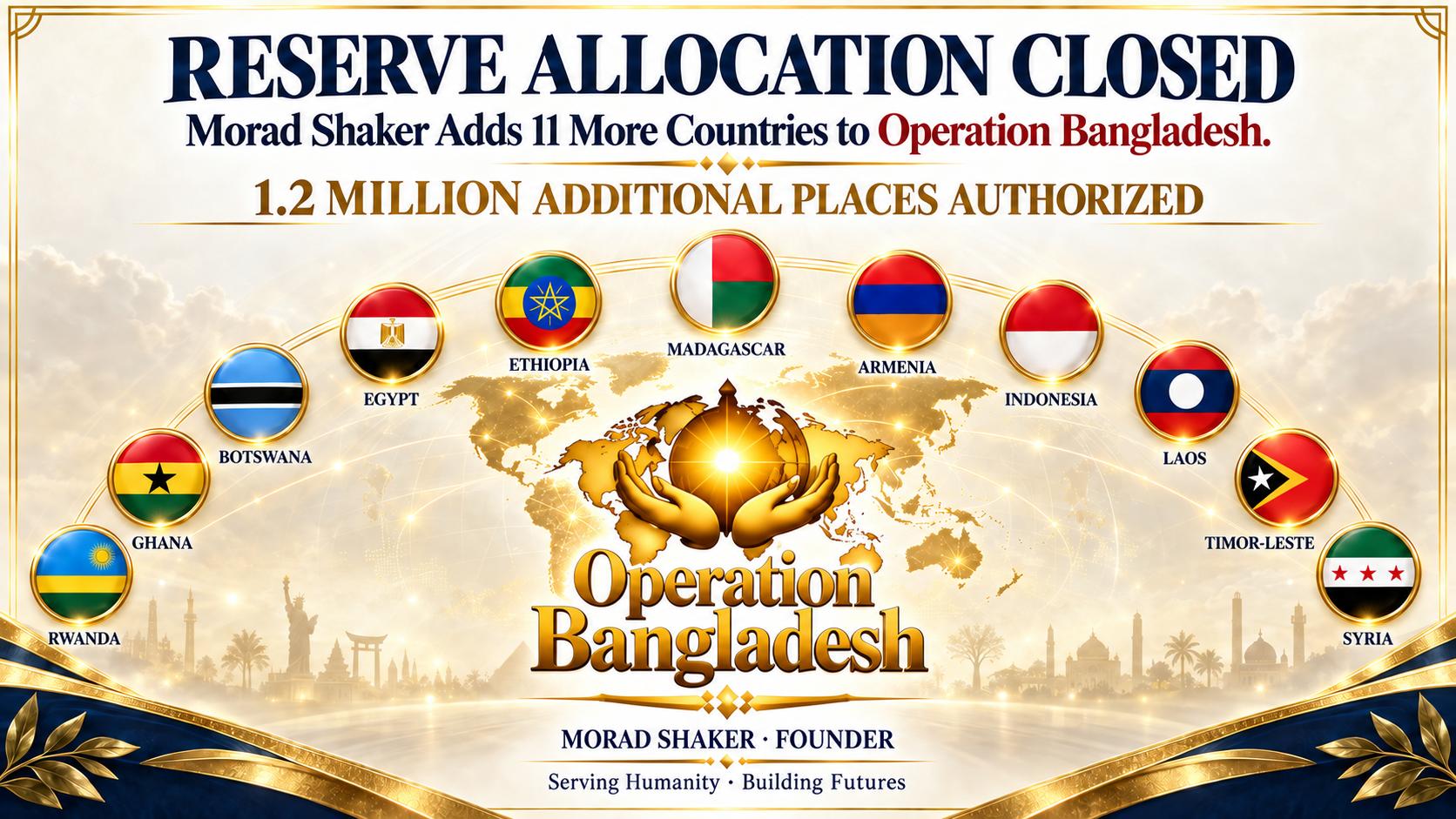
Operation Bangladesh has authorized another 1.2 million participation places across 11 countries, bringing the allocated portion of its original 10 million-person reserve to 9.5 million.
The countries added through the decision are Botswana, Ghana, Rwanda, Ethiopia, Madagascar, Egypt, Armenia, Indonesia, Laos, Timor-Leste and Syria.
The remaining 500,000 places have been frozen as a protected emergency reserve. According to Operation Bangladesh, those places will not be included in ordinary expansion and could be released only through a future decision by founder Morad Shaker in response to an exceptional humanitarian circumstance, security concern, urgent need, miscalculation or unforeseen development.
Operation Bangladesh says the authorization closes the allocation phase for the current reserve cycle.
Review behind the allocation
According to the organization, Shaker reached the decision after devoting more than 2,000 hours over the past 12 months to personal investigation, involvement, research and consideration. More than 1,500 of those hours reportedly occurred during the most recent six months.
The initiative says the review was conducted independently and was not a response to pressure from petitioners, governments, organizations or individuals.
Factors considered included World Bank and international-development data, population, poverty and income conditions, access to education, university capacity, technological readiness, opportunities for young people, regional balance and the practical ability to reach prospective participants responsibly.
The review also considered whether credible future connections could be developed through educational institutions, responsible local leaders, verified organizations and suitable public channels. Operation Bangladesh says its objective is to extend opportunity while maintaining the integrity of its participation process through careful, long-term decisions.
Eligibility does not confer approval or authority
The 11 countries differ in population, economic conditions, educational capacity and development needs. Operation Bangladesh says they are now eligible for possible future participation and program development.
However, the organization emphasized that inclusion does not mean a government has joined the initiative. It also does not indicate that a university, organization, company, representative or individual has been appointed, approved or confirmed.
No individual or organization may claim responsibility for securing a country's inclusion or use the allocation decision as a basis for asserting authority, according to the announcement. Activity in each country would remain subject to verification, the establishment of responsible local pathways and direct approval from the founder.
Founder-funded and independently directed
Operation Bangladesh describes itself as founder-funded and independently directed. It says its purpose is to develop future protections and opportunities for people who may lack financial resources, institutional access or opportunities because of where they were born.
The organization says expansion must remain controlled and connected to clear standards because opportunities can be misused without verification. It characterizes the 1.2 million newly authorized places as a future possibility rather than an immediate promise of participation.
Future work in the added countries is expected to involve further research, technology, engagement with universities, local verification and leadership. Operation Bangladesh says it intends to proceed carefully and avoid making false promises.
Final 500,000 places remain protected
With 9.5 million places allocated, the organization considers this stage of its reserve-allocation process complete. The remaining 500,000 places are being held for emergencies or exceptional future circumstances, including crises or needs that cannot currently be anticipated.
Operation Bangladesh says the protected balance will not remain available for routine expansion. The close of the allocation stage instead marks a transition to a more disciplined phase of development under the initiative's stated commitment, Serving Humanity. Building Futures.
Source: This report is based on an announcement published by Operation Bangladesh.